


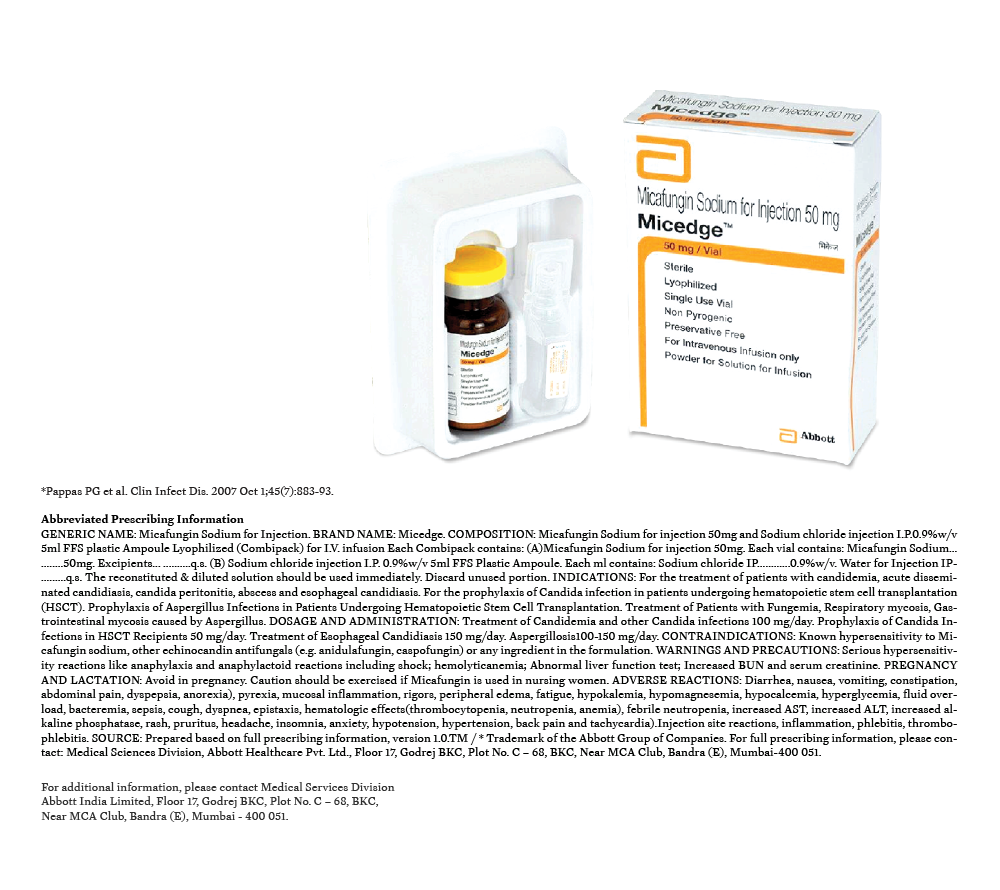
Micafungin Sodium for injection 50mg
MICEDGE
COMPOSITION:
Each combipack contains
: A) Micafungin Sodium for Injection 50mgEach vial contains: Micafungin Sodium equivalent to Micafungin.
…………….50 mg
Excipients………………………………q.s.
B) Sodium Chloride Injection I.P. 0.9% w/v (5ml FFS Plastic Ampoule)
Each ml contains
: Sodium Chloride I.P. ……………9.0 mg
Water for injection I.P……………q.s.
1. For the treatment of patients with candidemia, acute disseminated
candidiasis, candida peritonitis, abscess and esophageal candidiasis
2. For the prophylaxis of Candida infection in patients undergoing hematopoietic stem cell transplantation (HSCT)
3.
Dosing Instructions:
A loading dose is not required; typically, 85% of the steady-state concentration is achieved after three daily Micafungin doses. No dosing adjustments are required based on age, race, gender, or in patients with severe renal dysfunction or mild-to-moderate hepatic insufficiency.
The effect of severe hepatic impairment on micafungin pharmacokinetics has not been studied.
No dose adjustment for Micafungin is required with concomitant use of mycophenolate mofetil, cyclosporine, tacrolimus, prednisolone, sirolimus, nifedipine, fluconazole, voriconazole, itraconazole, amphotericin B, ritonavir, or rifampin. (See Drug Interactions).
Reconstitution
Please read this entire section carefully before beginning reconstitution.
The diluent to be used for reconstitution and dilution is 0.9% Sodium Chloride Injection, USP (without a bacteriostatic agent). Alternatively, 5% Dextrose Injection, USP, may be used for reconstitution and dilution of Micafungin. Solutions for infusion are prepared as follows:
Micafungin 50 mg vial
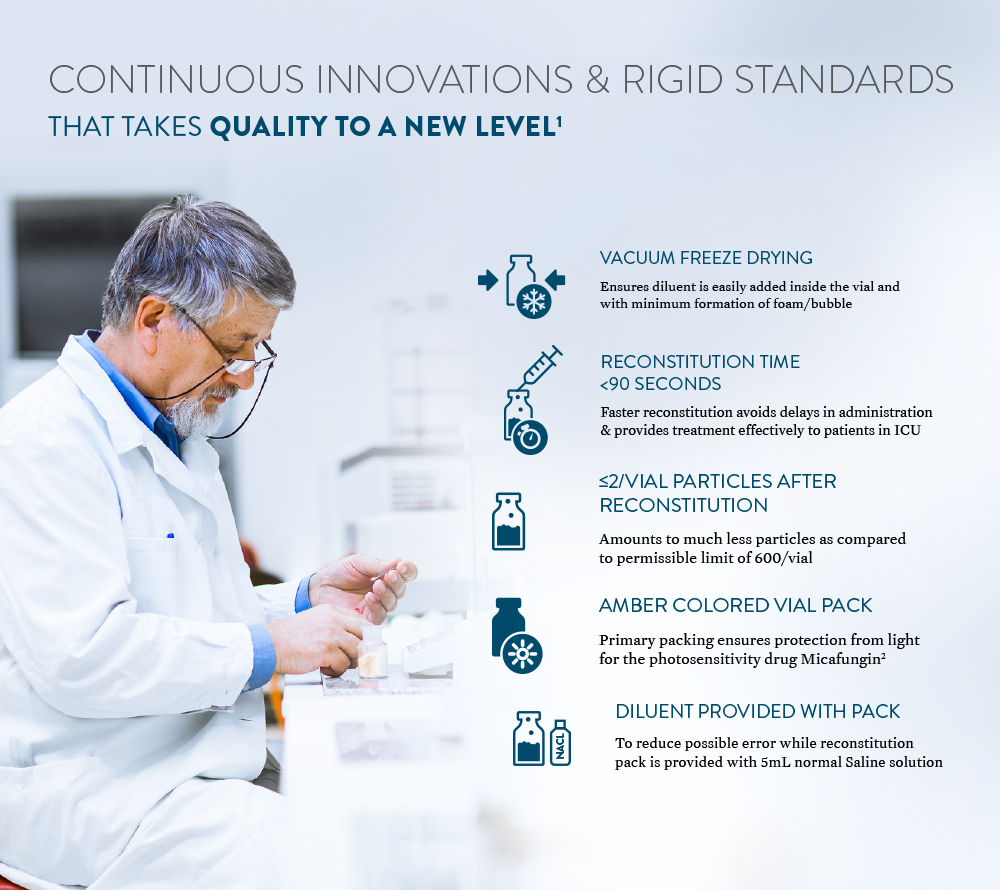
Aseptically add 5 mL of 0.9% Sodium Chloride Injection, USP (without a bacteriostatic agent) to each 50 mg vial to yield a preparation containing approximately 10 mg micafungin/mL.
To minimize excessive foaming, GENTLY dissolve the Micafungin powder by swirling the vial.
DO NOT VIGOROUSLY SHAKE THE VIAL.
As with all parenteral drug products, reconstituted Micafungin should be inspected visually for particulate matter and discoloration prior to administration, whenever solution and container permit. Do not use material if there is any evidence of precipitation or foreign matter. Aseptic technique must be strictly observed in all handling since no preservative or bacteriostatic agent is present in Micafungin or in the materials specified for reconstitution and dilution.
Dilution
The diluted solution should be protected from light. It is not necessary to cover the infusion drip chamber or the tubing.
Rate of Administration:
Micafungin sodium solutions should be administered by IV infusion over 1 hour; more rapid infusion may increase the risk of histamine mediated reaction.
Micafungin should not be admixed or infused concomitantly with other drugs. If the drug is to be administered via an existing IV line, the line should be flushed with 0.9% sodium chloride injection before the drug is infused Micafungin is preservative-free. Discard partially used vials. Candidemia and other Invasive Candida Infections: The recommended dosage of micafungin sodium for the treatment of candidemia, acute disseminated candidiasis and certain invasive Candida infection (peritonitis, abscesses) in adults is 100 mg once daily given by slow IV infusion. Oropharyngeal Candidiasis: The recommended dosage of micafungin sodium for the treatment of oropharyngeal candidiasis in adults is 100 or 150 mg once daily given by slow IV infusion. Prevention of Candida Infections in Hematopoietic Stem Cell Transplant Recipients: The recommended dosage of micafungin sodium for the prevention of Candida infection in adult hematopoietic stem cell transplant (HSCT) recipients is 50 mg once daily given by slow IV infusion. Aspergillosis: Micafungin sodium dosages of 100 or 150 mg once daily given by slow IV infusion have been recommended as salvage therapy for invasive aspergillosis, however, the optimal dosage and duration of antifungal treatment for these infections have not been established Guidelines for Adult Dosage
| Recommended Adults Dose (mg/day) | Indication |
| 100 | Treatment of Candidemia and other Candida infections |
| 50 | Prophylaxis of Candida Infections in HSCT Recipients |
| 150 | Treatment of Esophageal Candidiasis |
Micafungin is highly protein bound and, therefore, is not dialyzable. No cases of Micafungin overdosage have been reported. Repeated daily doses up to 8 mg/kg (maximum total dose of 896 mg) in adult patients have been administered in clinical trials with no reported doselimiting toxicity.
The minimum lethal dose of Micafungin is 125 mg/kg in rats, equivalent to 8.1 times the recommended human clinical dose for esophageal candidiasis based on body surface area comparisons.
Contraindications
Known hypersensitivity to micafungin sodium, other echinocandin antifungals (e.g anidulafungin, caspofungin) or any ingredient in the formulation.
Warnings/Precaution Sensitivity Reactions:
Hypersensitivity Reactions
Serious hypersensitivity reactions (e.g. anaphylaxis and anaphylactoid reactions including shock) have occurred in patients receiving micafungin. Possible histamine mediated symptoms (e.g. rash, pruritus, facial swelling) have occurred in patients receiving micafungin. Rapid IV infusion may increase the risk of histamine mediated reactions.
If serious hypersensitivity reactions occur, the micafungin infusion should be discontinued and appropriate therapy initiated.
Hematologic Effects:
Clinically important hemolysis and hemolytic anemia have been reported rarely in patients receiving micafungin. Transient acute intravascular hemolysis and hemoglobinuria (without clinically important anemia) was reported in a healthy individual receiving a 200 mg micafungin infusion in conjunction with oral prednisolone (20 mg daily) If clinical or laboratory evidence of hemolysis or hemolytic anemia occur during micafungin therapy, the patient should be closely monitored for evidence of worsening hemolysis or hemolytic anemia and the risks of continued micafungin therapy should be weighed against potential benefits of the drug.
Hepatic Effects :
Abnormal liver function test results have been reported in healthy individuals and patients receiving micafungin. Hepatic abnormalities, including clinically important hepatic dysfunction, hepatitis and hepatic failure have been reported in patients with serious underlying conditions receiving micafungin and multiple other drugs concomitantly. If abnormal liver function test results occur during micafungin therapy, the patient should be monitored for the development of worsening hepatic function and the risks of continued micafungin therapy should be weighed against potential benefits of the drug.
Renal Effects :
Increased BUN and serum creatinine concentrations have been reported in patients receiving micafungin. Clinically important renal dysfunction or acute renal failure have been reported rarely. If abnormal renal function test results occur during micafungin therapy, the patient should be monitored for the development of worsening renal function. Selection and use of Antifungals: Efficacy of micafungin sodium has not been established for treatment of infections caused by fungi other than Candida. Specific Populations: Lactation : Distributed into milk in rats; not known whether micafungin is distributed into milk in humans. Caution should be exercised if micafungin is used in nursing women. Pediatric Use : Safety and efficacy not established in children 16 years of age and younger.
Geriatric Use : No substantial differences in safety and efficacy in geriatric adults 65 years of age or older relative to younger adults but increased sensitivity cannot be ruled out.
Hepatic Impairment : In patients with moderate hepatic impairment (Child Pugh score 7-9), peak plasma concentration and AUC of micafungin are decreased approximately 22%; no dosage adjustment is necessary in such patients. Although pharmacokinetics has not been evaluated in patients with severe hepatic impairment (Child Pugh score exceeding 9), 4 worsening hepatic failure has been reported. The risks and benefits of continued micafungin therapy should be weighed if abnormal liver function test results occur during therapy.
Common Adverse Effects:
Adverse effects reported in 5% or more of patients receiving micafungin include GI effects (diarrhea, nausea, vomiting, constipation, abdominal pain, dyspepsia, anorexia), pyrexia, mucosal inflammation, rigors, peripheral edema, fatigue, hypokalemia, hypomagnesemia, hypocalcemia, hyperglycemia, fluid overload, bacteremia, sepsis, cough, dyspnea, epistaxis, hematologic effects (thrombocytopenia, neutropenia, anemia), febrile neutropenia, increased AST, increased ALT, increased alkaline phosphatase, rash, pruritus, headache, insomnia, anxiety, hypotension, hypertension, back pain and tachycardia). Injection site reactions (inflammation, phlebitis, thrombophlebitis) have been reported.
Effect on Antifungal Agents
Amphotericin B: Pharmacokinetics of micafungin is not affected by concomitant amphotericin B; micafungin dosage adjustments are not required. In vitro, the antifungal effects of micafungin and amphotericin B have been additive or synergistic against Aspergillus; no in vitro evidence of antagonism.
Fluconazole : No evidence of pharmacokinetic interactions when micafungin was used with oral or IV fluconazole; micafungin dosage adjustments are not required.
Itraconazole : Pharmacokinetic interaction with itraconazole (increase in the peak plasma concentration and are under the concentration time curve (AUC) of itraconazole; no effects on micafungin pharmacokinetics). Micafungin dosage adjustments are not required. Monitor for itraconazole toxicity and reduce itraconazole dosage if necessary.
Voriconazole : No evidence of pharmacokinetic interactions when micafungin was used with voriconazole; micafungin doage adjustments are not required. In vitro evidence of additive antifungal effects against Aspergillus. In vitro the antifungal effects of micafungin and voriconazole have usually been indifferent against Candida Immunosuppressive Agents Cyclosporine : Possible pharmacokinetic interaction (decreased oral clearance and increased half life of cyclosporine; no effect on micafungin pharmacokinetics). Although pharmacokinetic interactions between micafungin and cyclosporine probably are not clinically important in most patients, results of a study evaluating concomitant use of the drugs (a single cyclosporine dose and single or multiple micafungin doses) in healthy adults indicate that there is considerable interindividual variation and a clinically important increase in cyclosporine half life may occur in some patients. Micafungin dosage adjustments are not required if the drug is used concomitantly with cyclosporine. However, if micafungin is initiated or discontinued in patients receiving cyclosporine, cyclosporine concentrations be monitored carefully and dosage of the immunosuppressive agent adjusted as needed. Mycophenolate: No evidence of pharmacokinetic interactions when micafungin was used with mycophenolate; micafungin dosage adjustments are not required Sirolimus:
Pharmacokinetic interactions (increased AUC of sirolimus; no change in peak sirolimus plasma concentrations; no effect on micafungin pharmacokinetics). Micafungin dosage adjustments are not required. Monitor for sirolimus toxicity and reduce sirolimus dosage if necessary.
Tacrolimus : No evidence of pharmacokinetic interactions when micafungin was used with tacrolimus; micafungin dosage adjustments are not required. Prednisolone: No evidence of pharmacokinetic interactions when micafungin was used with prednisolone; micafungin dosage adjustments are not required. 5 Others
Nifedipine: Pharmacokinetic interaction with nifedipine (increase in the peak plasma concentration and AUC of nifedidpine; no effect on micafungin pharmacokinetics) Micafungin dosage adjustments are not required. Monitor for nifedipine toxicity and reduce nifedipine dosage if necessary. Rifampin: Pharmacokinetics of micafungin were not affected by concomitant rifampin; micafungin dosage adjustments are not required. Ritonavir: Pharmacokinetics of micafungin were not affected by concomitant ritonavir; micafungin dosage adjustments are not required.
Pharmacodynamic Properties:
Mechanism of Action
Micafungin is a semisynthetic lipopeptide (echinocandin) compound synthesized by a chemical modification of a fermentation product of Coleophoma empetri F-11899.
Micafungin is a member of a class of antifungal drugs known as echinocandins. It inhibits the synthesis of 1,3-β-D glucan, an essential component of fungal cell walls, which is not present in mammalian cells.
Microbiology
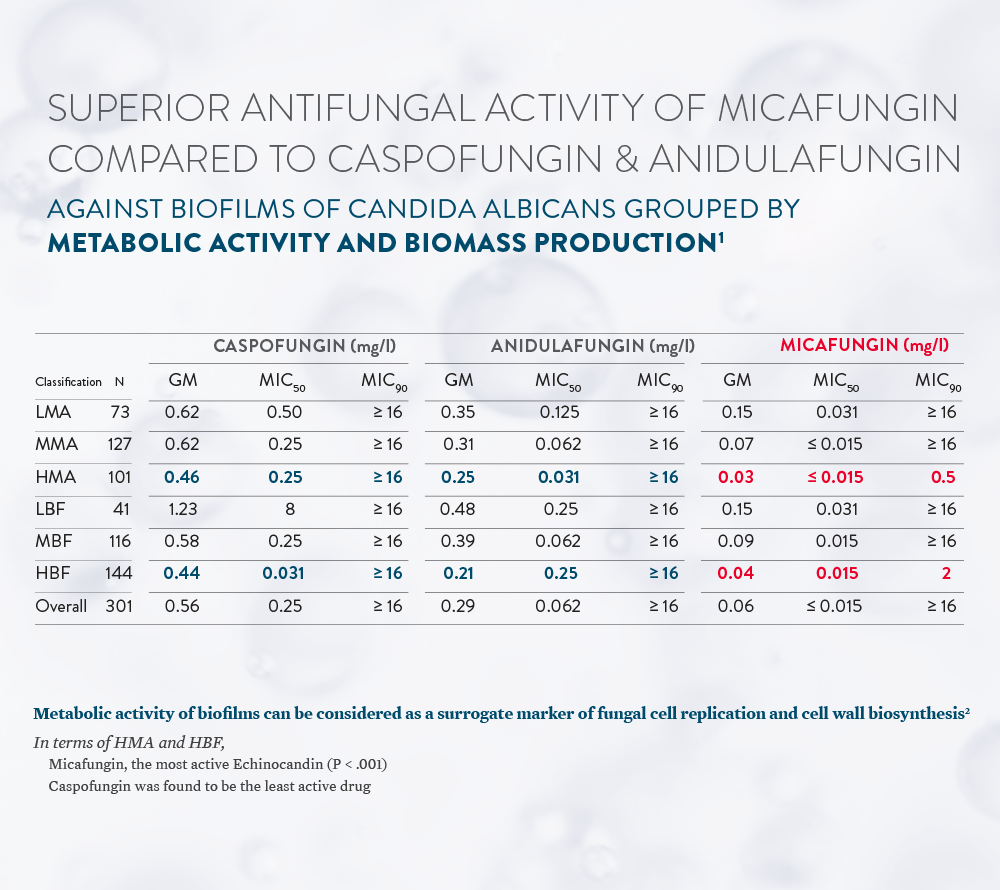
Micafungin sodium is active in vitro against Candida, including C. albicans, C. dubliniensis, C. glabrata, C. guilliermondii, C. krusei, C. lusitaniae, C. metapsilosis, C. orthopsilosis, C. parapsilosis and C.tropicalis. The drug also is active in vitro against Aspergillus, including A. fumigatus, A. flavus, A. niger and A. terreus. Like other echinocandins, micafungin is not active against Cryptococcus neoformans, Trichosporon or zygomycetes. The potential for development of resistance to micafungin is not known. C. albicians with reduced susceptibility to micafungin have been reported after long-term treatment with the drug. Resistance also has developed in C. parapsilosis. Some C.albicians with reduced susceptibility to micafungin also has reduced susceptibility to caspofungin.
| Organism | MIC 90 mcg/ml |
| C. albicans | 0.09 |
| C. glabrata | 0.0185 |
| C. tropicalis | 0.06 |
| C. krusei | 0.12 |
| C. Kelyr | 0.06 |
| C. parapisolis | 2 |
| C. lusitaniae | 0.25 |
| C. famata | 1 |
Pharmacokinetic Properties
| Parameters | Micafingin |
| Absorption | The pharmacokinetics of micafungin were determined in healthy subjects, hematopoietic stem cell transplant recipients, and patients with esophageal candidiasis or invasive candidiasis up to a maximum daily dose of 8 mg/kg body weight. The relationship of area under the concentration-time curve (AUC) to micafungin dose was linear over the daily dose range of 50 mg to 150 mg and 3 mg/kg to 8 mg/kg body weight. |
| Distribution | The mean ± standard deviation volume of distribution of micafungin at terminal phase was 0.39 ± 0.11 L/kg body weight when determined in adult patients with esophageal candidiasis at the dose range of 50 mg to 150 mg. |
| Protein Binding | Micafungin is highly (>99%) protein bound in vitro, independent of plasma concentrations over the range of 10 to 100 mcg/mL. The primary binding protein is albumin; however, micafungin, at therapeutically relevant concentrations, does not competitively displace bilirubin binding to albumin. Micafungin also binds to a lesser extent to α1-acidglycoprotein. |
| Metabolism | Micafungin is metabolized to M-1 (catechol form) by arylsulfatase, with further metabolism to M-2 (methoxy form) by catechol-Omethyltransferase. M-5 is formed by hydroxylation at the side chain (ω-1 position) of micafungin catalyzed by cytochrome P450 (CYP) isozymes. Even though micafungin is a substrate for and a weak inhibitor of CYP3A in vitro, hydroxylation by CYP3A is not a major pathway for micafungin metabolism in vivo. Micafungin is neither a P-glycoprotein substrate nor inhibitor in vitro. |
| Excretion | The excretion of radioactivity following a single intravenous dose of 14C-micafungin sodium for injection (25 mg) was evaluated in healthy volunteers. Micafungin is excreted principally in feces; 71% of a dose is eliminated within 28 days. Micafungin is not removed by dialysis. |
| Half Life | The mean plasma half-life of micafungin in adults is 13.4 – 17.2 hours |
Store at a temperature not exceeding 25oC. Protect from light
Storage:
Unopened vial must be stored at a temperature 2°C to 8°C. Storage of Diluted Product
The diluted infusion should be protected from light and may be stored for up to 24 hours at room temperature, 25° C.
BDR Pharmaceuticals Intl’ Pvt. Ltd.
Shivam Complex No. 1, S-11, B/4,
Dunetha, Nani Daman- 396210
At, Survey No. 46/1-4, Kadaiya Village, Nani Daman- 396210, India
Abbott healthcare Private Limited
Angel Space, Bldg. D-4, Gala No. 1 to 6 & 11 to 16 Ground Floor, 101 to 106 & 111 to 116
First Floor, 201 to 206 & 211 to 216 2nd Floor, Pimplas, Dist. Thane, Bhiwandi – 421 302,
India.


©2025 Abbott, All Rights Reserved.
Unless otherwise specified, all product and service names appearing in this Internet site are trademarks owned by or licensed to Abbott, its subsidiaries or affiliates. No use of any Abbott trademark, trade name, or trade dress in this site may be made without the prior written authorization of Abbott, except to identify the product or services of the company.